You picked out a gorgeous watch, wore it constantly, and a few months in, you notice it — the finish isn’t quite as luminous as the day it arrived. Maybe there’s a faint shadow forming near the clasp, or the overall tone just feels a touch flatter than you remember.
Before you jump to “I got a bad piece,” take a breath: this is genuinely one of the most common (and most fixable) things that happens to gold-tone watches, and once you understand the why, the how-to-prevent-it part is easy.
Why Fading Happens in the First Place
Let’s start with something most brands don’t say out loud: unless you’re buying solid precious metal or a watch that costs several thousand dollars, the gold-tone piece on your wrist is gold-plated, not solid gold. And every gold-plated watch will fade at some point.
That’s simply how plating works: it’s a fine layer of genuine gold bonded onto a base metal beneath it, and that layer, however well it’s made, was never going to last forever. What changes is how long it takes before you notice — and that comes down almost entirely to how thick and how carefully that layer was applied, plus the quality of the metal underneath it.
This is exactly why price tends to tell you something real. A watch built on thin, corner-cut plating can start looking tired within a month or two of regular wear, simply because there was barely a gold layer to begin with. It’s one of the quickest tells of a cut-rate piece: if a “gold” watch dulls, rusts, or visibly fades almost immediately, thin plating is nearly always the culprit.
gold-plated-watch-oxidation-wear-details 1-1
gold-plated-watch-oxidation-wear-details 1-2
Our gold plating is applied thicker and more evenly than what you’ll typically find on lower-cost pieces, which is why our watches tend to hold their color and shine noticeably longer through everyday wear. That said, we’re not going to tell you plating lasts forever — because it doesn’t, on any watch. Our promise isn’t “this will never fade.” It’s “this will fade slowly, and only if it’s genuinely neglected.”
Even with excellent plating, though, nothing metal stays completely static forever. Two things tend to happen, both very slowly:
The outer layer thins with wear. Everyday friction — your skin, your sleeves, just living your life — gradually rubs at that top layer. Good plating hides this for a long time, but high-contact spots (the clasp, the case back, the edges of the band) will always show it first if the watch is worn hard, day in and day out.
The base metal starts to react. A tiny scratch or a thin patch in the plating is enough to expose what’s underneath to air, moisture, and sweat — and that can trigger a chemical reaction that dulls or discolors the surface. Once that begins, it usually reveals itself as a shadow or a subtle color shift.
Neither of these means something’s wrong with your watch. It’s just what happens to metal over years of normal life, and with strong plating, it happens far more slowly than with the cheap stuff. The better the plating, the longer that clock takes to run out — and a bit of care stretches it out even further.
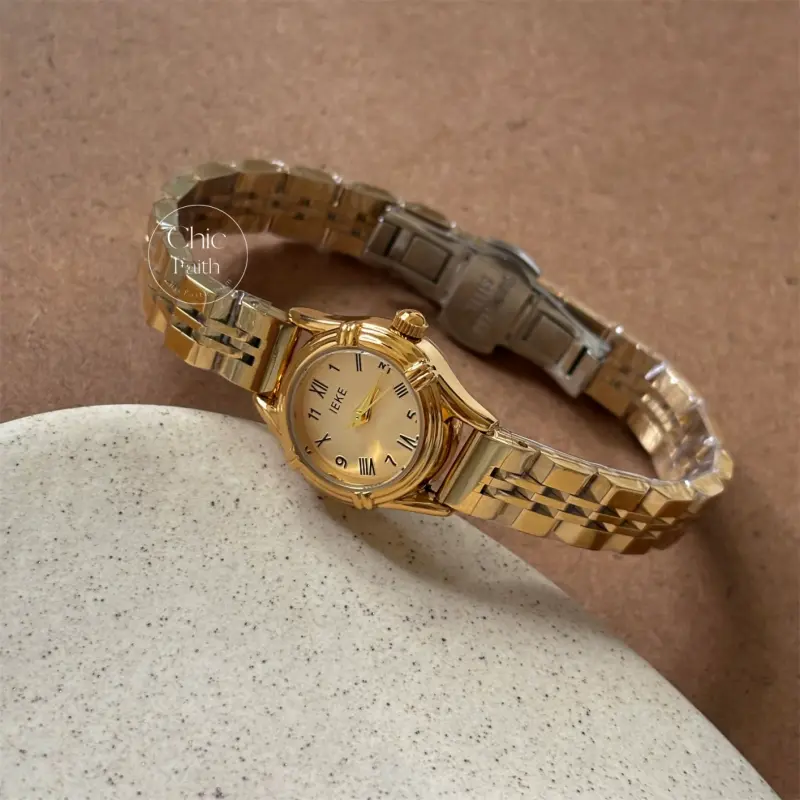
Vintage-Inspired Gold/Silver Round Small Face Bracelet Watch for Women
The Real Culprits Behind Fading
Fading is rarely the result of one big moment — it’s the slow accumulation of small, everyday exposures:
Sweat: Naturally acidic, and constant contact wears at the finish while reacting with the metal beneath it.
Water (especially chlorine and saltwater): Pool chemicals and ocean salt are among the fastest ways to dull a watch.
Sunscreen, lotion, and perfume: The chemicals in these products can react with metal or break down the finish — a summer-specific hazard if there ever was one.
Humidity: Moisture in the air speeds up the same fading reactions, indoors or out.
Friction: Ongoing contact with clothing, desks, or gym gear wears a finish down faster than occasional, gentle wear ever would.
Notice the pattern? Almost every item on that list spikes in summer — more sweat, more sunscreen, more days at the pool. If your watch seems to lose its shine faster in July than in January, that’s not in your head.
Vintage-Inspired Gold/Silver Round Dial Ladies Watch Classic Small Face Watch
Can You Shower, Swim, or Head Into the Ocean With It On?
This is far and away the question we hear most, and here’s the honest answer: it depends on the watch, but “water-resistant” was never the same thing as “fade-resistant.” Even a watch that comes through a splash unscathed can still take a hit to its finish over time. Let’s go scenario by scenario.
🚿 Showering: It’ll survive, but we wouldn’t recommend it
Most water-resistant watches can physically handle a shower without any malfunction. The issue isn’t function, though — it’s finish. Hot water opens up tiny pores in the metal’s surface, and the combination of shampoo, body wash, and steam accelerates wear far more than a quick splash would. Shower with it on regularly, and don’t be shocked if it looks noticeably duller within a few months. Taking it off costs you five seconds and buys you the cheapest insurance you’ll ever get.
🏊 Swimming pools: About as rough as it gets
Chlorine is genuinely aggressive toward metal — it’s designed to break down organic material, and it makes no distinction between bacteria and a delicate gold finish. Pool water is consistently one of the fastest ways to dull a watch’s shine. Heading to the pool is a hard no: take it off and stash it somewhere dry.
🏖️ Ocean and saltwater: Worse than most people expect
Salt water corrodes in a way plain water doesn’t — the salt itself reacts with metal surfaces, and it has a habit of lingering in clasps and crevices long after you’ve toweled off, quietly doing damage for hours afterward. Add sand (mildly abrasive) and leftover sunscreen into the mix, and a beach day manages to hit nearly every fading trigger at once. Want to wear it to the beach just for the look? Totally fine — just take it off before you actually go in.
🚴 Sweat and the gym: Easy to overlook, but very real
A watch doesn’t need to be submerged to react with moisture. Sweat is salty and acidic, and a solid workout means prolonged, direct contact with your skin plus a steady dose of moisture — surprisingly close to a light saltwater exposure. If you’re working out daily, a simple rule helps: gym watch off, everyday watch on.
🧼 Handwashing and dishes: Low-key, but it adds up
An occasional quick handwash won’t do much on its own. But repeated exposure to dish soap, hot water, and friction throughout the day is exactly the kind of small, constant wear that leads to gradual fading. Doing dishes or a deep clean? The ten seconds it takes to slide the watch off is worth it.
A Note on Winter Steam: In colder months, washing your hands (or showering) in hot water generates a lot of steam. That steam is warm enough to work its way into the tiny gaps around the case and clasp more easily than room-temperature water would, and it tends to sit there instead of evaporating quickly. This heat-plus-trapped-moisture combination is genuinely tougher on the finish than a quick rinse of cool water.
🛌 Sleeping: No water involved, but still worth a mention
Sleeping in your watch doesn’t expose it to water, but it does mean hours of skin contact, body heat, and friction against your sheets — all of which wear at the finish over time. It’s not going to ruin a watch in one night, but it’s one more small habit that compounds if it’s a nightly thing for years on end.
The easiest rule of thumb: If you wouldn’t wear a great pair of leather shoes into the shower or the ocean, extend the same courtesy to your watch. Taking it off and putting it back on takes seconds, and it’s the single most effective habit on this entire list.
7 Approved Habits to Prevent Fading
Take it off before anything water-related. As covered above, showers, pool days, and ocean trips are the biggest accelerators of all. Even a water-resistant watch benefits from staying dry when it doesn’t have to get wet.
Put it on last, take it off first. Let your sunscreen, lotion, and perfume fully absorb before you put your watch on. These products are among the most common — and most avoidable — causes of dullness.
Give it a quick wipe-down after wearing it. A soft, dry microfiber cloth at the end of the day clears away sweat, oils, and residue before they get a chance to wear at the finish. This one habit alone prevents most everyday buildup.
Store it with intention, not just wherever. Tossing your watch into a drawer with other jewelry invites scratches and speeds up fading through trapped moisture and friction against other pieces. Give it its own space — a soft pouch or a lined box, kept somewhere dry.
Keep it out of direct sunlight for long stretches. Light, including sunlight and certain indoor bulbs, contributes to surface dullness over time. A watch parked on a sunny windowsill isn’t doing itself any favors.
Clean it gently — never aggressively. A soft cloth with mild soap and water goes a long way. Skip anything abrasive, harsh, or acidic — it’ll strip a fine finish rather than restore it.
Let it rest sometimes. Counterintuitively, watches worn constantly often hold up better than ones worn occasionally and stored carelessly in between. If you’re rotating pieces, make sure the “resting” ones are stored properly, not tossed loose into a bag or car console.
chicfaith packing content
Taking care of your watch doesn’t have to be complicated. To make those daily habits easy, every Chic Faith order arrives as a complete set. We include our custom Polishing Cloth for a quick wipe-down after wear, and a sturdy Watch Box for safe, dry storage. Complete with a band adjuster, alcohol pads, and a mystery gift, we’ve provided all the essentials so you can keep your watch shining like new without any extra effort.
Quick Answers
Can I wear my watch in the shower?
It probably won’t break it, but hot water, soap, and steam accelerate fading. Better to take it off.
Can I swim with it on?
We wouldn’t recommend it, even for water-resistant styles — chlorine and saltwater are two of the fastest ways to dull the finish.
Will sunscreen ruin it?
It can. The chemicals in sunscreen can react with the finish and dull it, especially with repeated exposure. Apply it before you put your watch on.
Does sweat actually damage it?
Yes, gradually. Sweat is mildly acidic, and daily contact over months adds up in a way similar to light water exposure.
Is it bad to sleep in my watch?
It won’t ruin it overnight, but hours of nightly skin contact and friction is the kind of small, repeated wear that speeds up fading over time.
The Bottom Line
Fading isn’t a sign that anything’s wrong with your watch — with a high-quality finish, it takes real, sustained neglect for it to become noticeable.
And the good news is that the habits that prevent it are genuinely small: take it off before water, let your skincare absorb first, wipe it down at the end of the day, and store it somewhere dry. None of it costs you more than a few extra seconds — and that’s the entire difference between a watch that looks tired after one summer and one that still looks brand new for years to come.
 Skip to content